
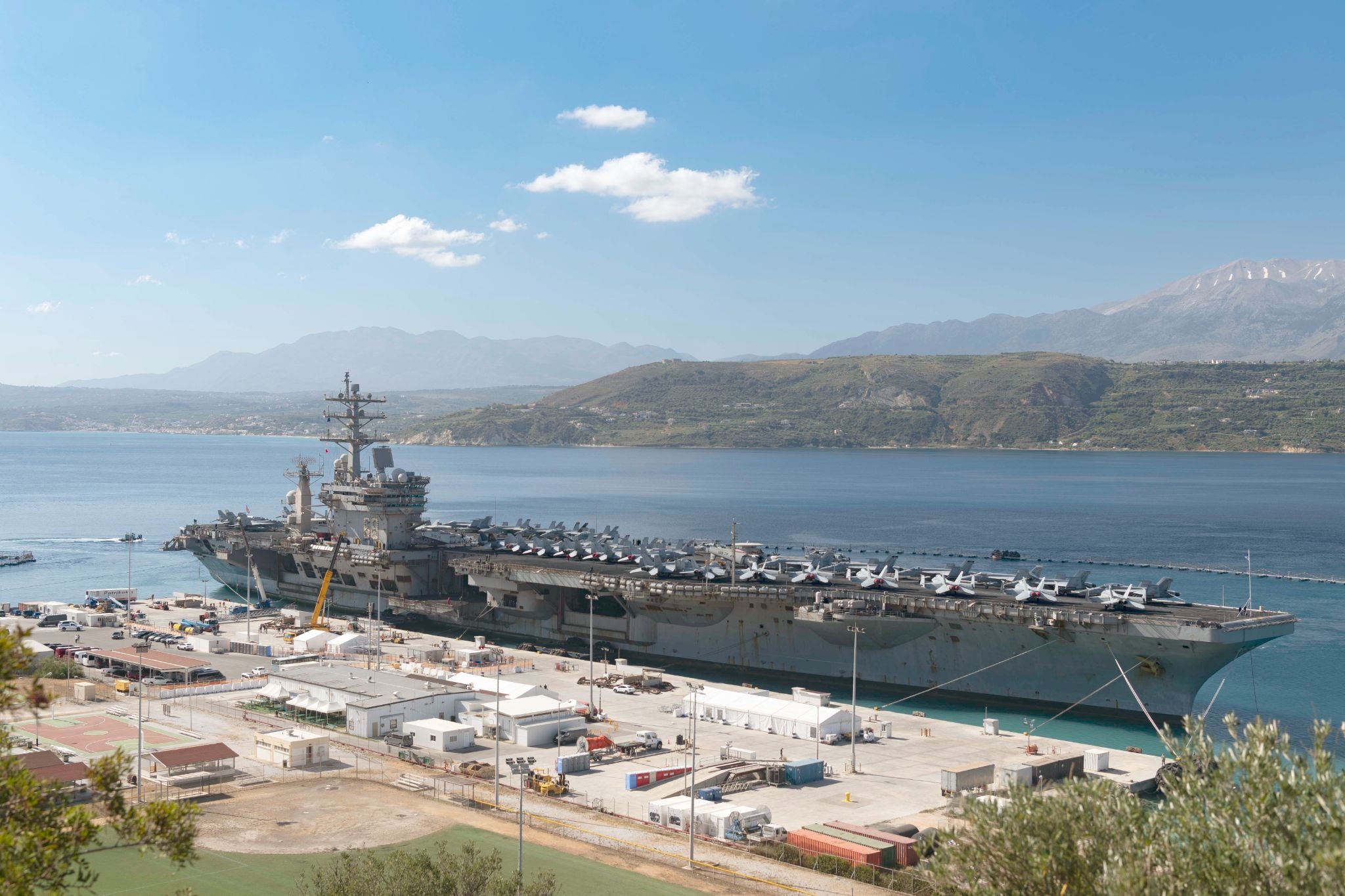
In May 2026, a Greek court convicted a 26-year-old Azerbaijani national known only by his initials “NJ” for espionage that targeted the NATO/US naval base in Souda Bay in Crete. An important strategic asset in the eastern Mediterranean, the base is one of the few in the region capable of hosting an aircraft carrier pierside. This case, and two similar cases, are reminiscent of a 1940-43 German espionage case that targeted the US military in Norfolk, Virginia.
The Iranian’s asset, NJ, reportedly entered Greece in January 2025 using either a Polish passport or a residence permit. Once in Greece, he purchased a camera, memory cards and other photography equipment and traveled to Crete in early June where he paid in cash for a month-long stay at the Christi Apartments Hotel along the Souda Bay waterfront in Kalyves, located just behind the mast of USS GERALD R. FORD (CVN-78) in the 2023 photograph above. Using his room as a vantage point, he spent days on the balcony taking over 5,000 photos of ships entering and leaving Souda Bay, only leaving the hotel room twice during four days of observation by the Hellenic National Intelligence Service (EYP). NJ was arrested by Greek police on June 22-23rd, with investigators finding 23 videos of HS KOUNTOURIOTIS (F-462), which docked in Souda on June 21st. Investigators also found a laptop with encryption software installed, which NJ allegedly used to transfer the photographs via the memory cards. The recipient of the encrypted material is ultimately unknown, but officials strongly suggested it was Iran’s Islamic Revolutionary Guard Corps (IRGC).

This was not an isolated incident. Also in June 2025, police in Cyprus arrested Rashad Sultanov, a 40-year-old dual citizen of Azerbaijan and the United Kingdom. He was arrested in the Zakaki neighbourhood of Limassol, approximately six miles from Royal Air Force Base Akrotiri. Sultanov had been living there since April, renting an apartment overlooking the base. On June 20th, he traveled to Paphos airport, a joint civil-military public airport in southwestern Cyprus, to observe and photograph the deployment of US Marines and aircraft.
Additionally, back in Crete, in March 2026 a 36-year-old Georgian national of Azerbaijani descent, Samir G., was arrested in Athens Airport. The suspect arrived in Greece via Germany in February 2026 where he stayed in the Souda Bay area and reportedly arranged to rent a villa across the bay from the naval base. While attempting to leave in March 2026, he was detained in Athens Airport where photographs of the USS Gerald Ford were found on his cell phone.
Based on what is publicly known, the IRGC’s Intelligence Organization (IRGC IO), particularly elements such as Unit 4000, the covert-action, special operations directorate within the IRGC IO, appear to have increasingly relied on:
- Foreign nationals rather than Iranian citizens (or Iranian diaspora)
- Individuals of Azerbaijani background
- EU residency/citizenship/visas who can travel freely
These techniques provide a buffer for the IRGC to obfuscate responsibility if these operatives are caught. An April 2026 Israeli statement specifically described a global IRGC espionage network run through Unit 4000 that recruits among Azerbaijani communities within the former Soviet Union, likely through the Iranian-Azerbaijani community. These operatives are able to travel freely and legally within the European Union and thus evade initial suspicion. This method of intelligence operation is inherently more secure, as reports are sent electronically or digitally. Additionally, the operatives may not be aware of any other aspects of the network apart from their handler, who is almost certainly in Iran. In fact, if the IRGC relies on networking to recruit its operatives, these operatives may have never even spoken to an IRGC officer directly. This multilayered compartmentalization keeps the network safe from exposure and makes the operative cheap to replace when arrested.
Historically, this situation appears to parallel aspects of Waldemar Othmer’s one-man German intelligence (Abwehr) operation in Norfolk Virginia from 1940-43. Like NJ, Sultanov, and Samir G., Othmer’s form of espionage was to simply observe and report on military activity in the Virginia Tidewater region in 1940. Of greatest interest to the Germans was the quantity and composition of Atlantic convoys shipping Lend-Lease supplies to Britain. NJ, Sultanov and Samir G appear to have had similar roles, to provide information about the movement of US and NATO navy ships.
The difference between 2025 and 1940 is that Othmer’s reports were sent via mail and invisible ink instead of via the internet. However, this ineffective method of using mail and invisible ink to make reports was also an advantage, allowing him to evade capture and even detection for years while other Abwehr agents using radios were easily caught once the FBI turned their sole radio operator into a double agent. Because he used the mail, Othmer’s espionage remained hidden despite his open association with national socialism and the German-American Bund as well as several trips to Bremen between 1938-40. The confession of a fellow Abwehr trainee and his reliance on invisible ink, specifically the Abwehr’s recipe, was in the end his undoing as his need to seek out Pyramidon, a European painkiller not typically sold in the United States but used by the Abwehr to make invisible ink, was eventually noticed by the FBI in 1944.
Advances in communications technology over just the past few years have radically changed the relative utility of observational espionage. While the strategic importance of Othmer’s work was questionable, his information did demonstrate that the United States was preparing for war with Germany over a year in advance. However, by the time his letters made it to the Abwehr office in Bremen, U-boats deep in the Atlantic likely struggled to take advantage of weeks-old data. The information from Souda, on the other hand, was allegedly transmitted digitally, allowing the IRGC to receive tactical information within minutes, and to program and launch drones or ballistic missiles almost immediately if desired.
Sources:
Stephen Ruder, 2025, Treasonous Tides, pp 92-103. https://www.usmcu.edu/Outreach/Marine-Corps-University-Press/Books-by-topic/MCUP-Titles-A-Z/Treasonous-Tides/
ERT News, June 23, 2025, Crete: 26-year-old Azeri man arrested for photographing the aeronautical bases in Souda. https://www.ertnews.gr/perifereiakoi-stathmoi/chania/kriti-synelifthi-26xronos-azeros-na-fotografizei-tis-aeronaytikes-vaseis-sti-souda/
ERT News, June 23rd, 2025, Espionage case in Crete – Arrest of Azeri photographing NATO base in Souda. https://www.ertnews.gr/eidiseis/ellada/ypothesi-kataskopeias-stin-kriti-syllipsi-azerou-pou-fotografize-ti-vasi-tou-nato-sti-souda/
Yannis Souliotis, June 24th, 2025, How the Azeri spy was moving under the radar of the Authorities. https://www.kathimerini.gr/society/563679649/pos-o-azeros-kataskopos-kinoyntan-kato-apo-ta-rantar-ton-archon/
Alexandros Kalafatis, March 2nd, 2026, Arrest of a Georgian suspect for espionage near the Souda base. https://www.ieidiseis.gr/ellada/707949/syllipsi-ypoptoy-georgianoy-gia-kataskopeia-konta-sti-vasi-tis-soydas
Dimitris Popotas and Aria Hut, March 3rd, 2026, The profile of the Georgian spy and the coded phrase troubling the authorities – It was circulated with a hat and glasses. https://www.newsit.gr/ellada/to-profil-tou-georgianou-kataskopou-kai-i-kodikopoiimeni-frasi-pou-provlimatizei-tis-arxes-kykloforouse-me-kapelo-kai-gyalia/4615691
Monitori, March 11th, 2026, Georgian Citizen Arrested in Crete Had Studied in Iran https://monitori.ge/en/georgian-citizen-arrested-in-crete-had-studied-in-iran/
Israel Ministry of Foreign Affairs, April 20th, 2026, Mossad, IDF and ISA Joint Announcement. https://www.gov.il/en/pages/mossad-idf-and-isa-joint-announcement-20-apr-2026
ERT News, May 20, 2026, Chania: Seven-year prison sentence without parole for Azeroth convicted of espionage. https://www.ertnews.gr/roi-idiseon/xania-poini-katheirksis-epta-eton-xoris-anastoli-ston-azero-pou-katadikastike-gia-kataskopeia/