
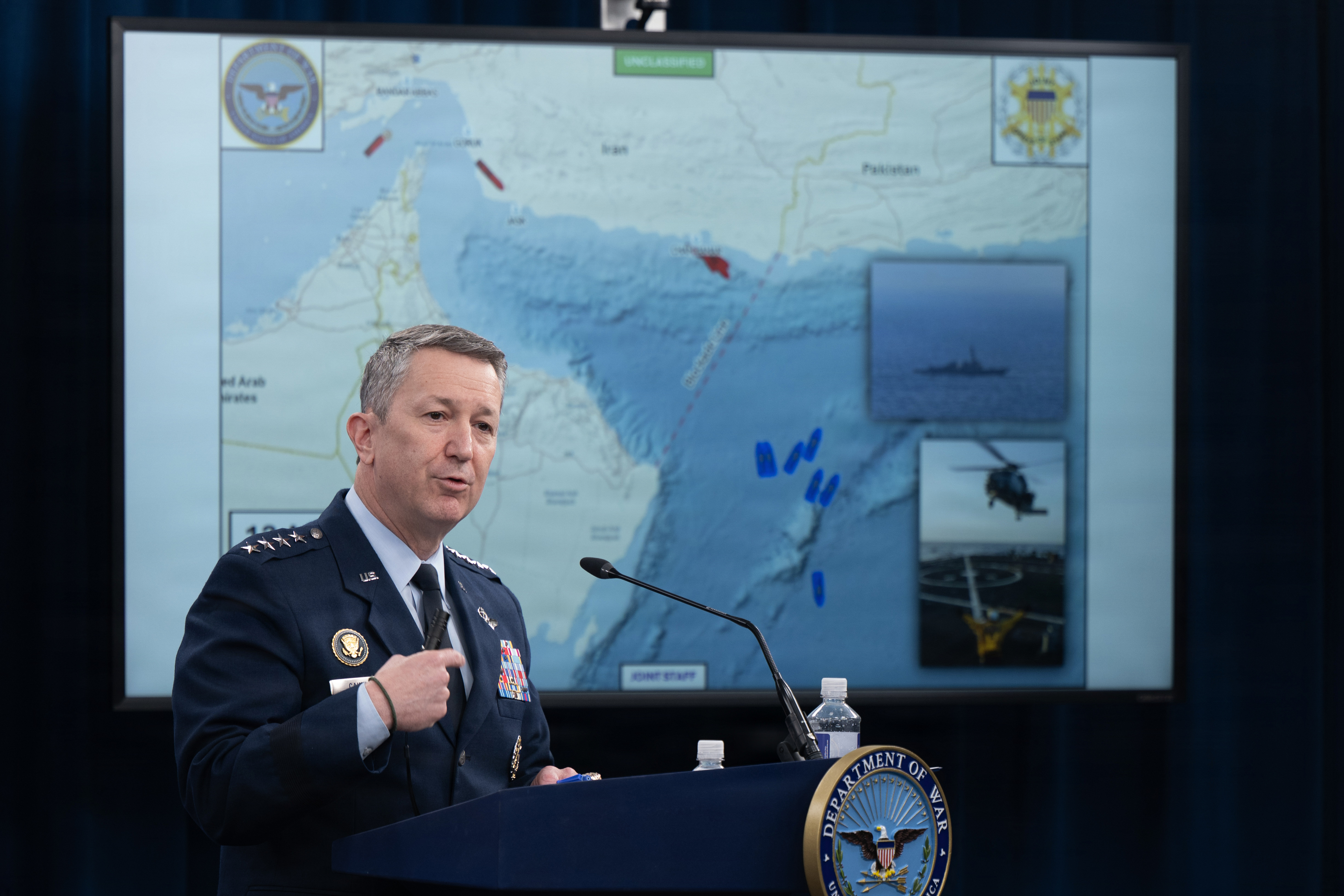
Chairman of the Joint Chiefs of Staff at a press briefing on Operation Epic Fury on April 16, 2026.
According to a report published by the Artificial Intelligence company Anthropic in September 2026, sometime during December 2025 and August 2026 an “Iran-nexus threat actor” used the company’s AI model titled “Claude” to collect and analyze publicly available information to attempt to track US Navy unit locations. The individual compiled information including:
- A roster of US personnel scraped from captions on public military photographs to follow them to see if they revealed their location;
- Publicly accessible ship (AIS) and aircraft transponder (ADS-B / Mode) identifiers to more easily locate US Navy ships and aircraft that are publicly sharing their location;
- Commercial satellite-imagery query scripts to more easily locate usable commercial imagery that might reveal the location of a US Navy ship at sea;
- An inventory of public websites that exposed US naval movements; and
- Known Common Vulnerabilities and Exposures (CVEs) in maritime VSAT (Very Small Aperture Terminal) to enable locating those emitters.
Anthropic’s report said the company banned the individual’s account, developed detections to reduce the risk of future misuse, and shared the information with unidentified government authorities. The individual’s exact relationship to the Iranian government or military was not revealed.
While some accounts of the Anthropic report expressed alarm, all of the information compiled by the “Iran-nexus threat actor” are common Open-Source Intelligence (OSINT) tools used to track ships that are attempting to avoid detection. Even the use of artificial intelligence for maritime tracking is a technique now being employed by OSINT researchers. However, those researchers also emphasize the fallibility of artificial intelligence and the need to verify results. Notably, the Anthropic report was silent about the accuracy of the US Navy research compiled by the Iran-nexus OSINT researcher using Claude.
Most significantly, gathering and collating publicly available defense information does not contravene the US espionage statute as was affirmed over 80 years ago in United States v. Heine in November 1945. As the judge noted at the time, “When the information has once been made public, and has thus become available in one way or another to any foreign government, the “advantage [to a foreign power]” intended by the [espionage statute] cannot reside in facilitating its use by condensing and arranging it.” While a vexing operations security (OPSEC) problem for the US Navy, the Anthropic revelation is not a unique development, is not known to have successfully tracked US Navy ships, and it was not espionage.
Anthropic, September 10, 2026, Detecting and countering misuse of AI: September 2026, https://www.anthropic.com/threat-intelligence-report-september-2026#surveillance-operations-sep-26
SOCRadar, April 21, 2026, Maritime OSINT: Tracking Dark Ships & Shadow Fleets, https://socradar.io/blog/maritime-osint-dark-ships-shadow-fleets/
UK OSINT Community. Mastering OSINT with Rae Baker: AI, Maritime Intelligence & Analyst Mindset, February 18, 2025, https://www.youtube.com/watch?v=Ca3LctQrRac&t=1698s
Wall Street Journal, September 11, 2026, Anthropic Says Iran Used Its American AI Model to Target U.S. Navy Warships, https://www.wsj.com/politics/national-security/anthropic-says-iran-used-its-american-ai-model-to-target-u-s-navy-warships-67583e05
U.S. Court of Appeals for the Second Circuit, November 8, 1945, United States v. Heine, 151 F.2d 813 (2d Cir. 1945), https://law.justia.com/cases/federal/appellate-courts/F2/151/813/1488654/
DoW photo by U.S. Navy Petty Officer 2nd Class Carson Croom, 260416-D-BI507-2717, https://www.dvidshub.net/image/9620088/sw-cjcs-conduct-pentagon-press-briefing